Regional Studio Monitor Preferences: How Culture Shapes Sound Choices
By Lila Okafor • 21st Jan
Do cultural differences actually dictate what makes a good studio monitor? The short answer: not in the way most producers think. As I analyze studio monitor specifications and performance across regions, I consistently find that regional studio monitor preferences are more myth than measurement. When you're working at 0.7 to 1.2 meters from your speakers in an 8x10 to 12x14 ft room (the reality for most bedroom producers), the physics of sound in small spaces matters far more than supposed cultural taste differences. Cultural sound preferences for consumer listening don't translate to professional monitoring needs, where accuracy is paramount regardless of geography. Curves matter, but only as far as rooms allow.
This FAQ deep dive separates evidence from anecdote using acoustic measurement data, market analysis, and the simple physics of how sound behaves in compact spaces. Let's cut through the marketing noise with a critical lens that focuses on what actually helps you finish mixes that translate globally.
Are there scientifically validated regional differences in studio monitor sound preferences?
What do the studies actually say?
The popular belief that "Americans prefer bass, Japanese prefer midrange, Germans like brightness" is largely anecdotal and untested in controlled settings. Research cited in the What's Best Forum discussion confirms: "Very little research has been done in cross-cultural preferences in the sound quality of reproduced sound. What we know is that different cultures have similar perceptions of the sound, but may use different language or descriptors to describe the attributes."
Industry-wide testing by major broadcasters (BBC, CBC, NHK) reveals a striking consensus: international audio standards prioritize "flat on-axis response, extended bandwidth in bass and treble, smooth off-axis response and low distortion." These universal criteria reflect what matters for professional work, not cultural preferences. When you're mixing dialogue for a global audience or mastering a track destined for streaming worldwide, consistent translation trumps regional taste.
Why small-room engineers should be skeptical of "cultural tuning" claims
As a data-oriented mixer who tests how curves behave at one meter in compact rooms, I've seen this myth cause real problems. A client once loved a showy top-end until I overlaid their room's 200 Hz bump from the desk. We cut the desk height, tweaked toe-in, and dropped a low-latency shelf, they kept the sparkle without needing revisions. If desk reflections are skewing your mid-bass, follow our monitor height and placement guide. That's when I fully trusted curves paired with context.
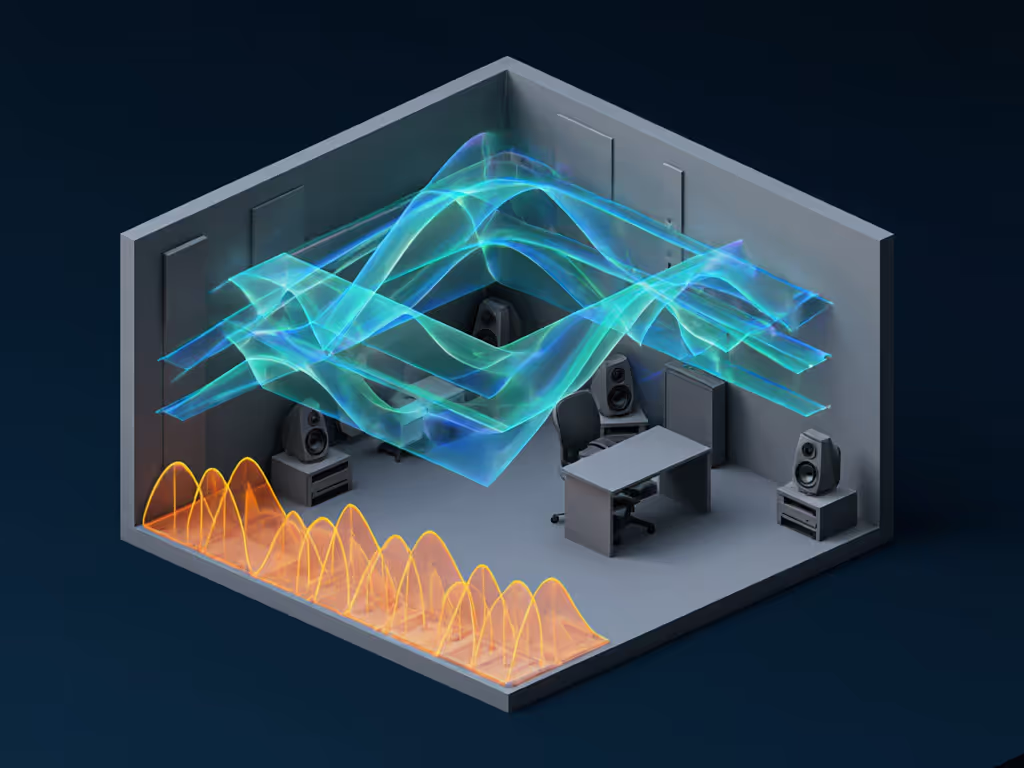
Commercial speakers marketed with "regional voicing" often mask room interaction issues rather than addressing them. In reality, your small room's modal behavior between 60 to 120 Hz will dominate your low-end perception regardless of nationality. This is why controlled directivity and smooth power response make small rooms more predictable, a universal truth that transcends cultural boundaries.
If cultural preferences aren't driving design, what does global market data reveal?
Global monitor market analysis: Consistency over customization
Global monitor market analysis shows manufacturers aren't creating region-specific models. The Verified Market Research report confirms that "the Studio Monitor Speaker Market is segmented by geography... but measurements of loudspeakers from different countries of origin tend to aim towards the same performance target."
While market share varies geographically (North America dominates currently), product specifications don't. Manufacturers like Adam Audio (Germany), Neumann (Germany), Yamaha (Japan), and KRK (USA) all target the same fundamental accuracy metrics for professional models. This isn't coincidence, it's because accurate reproduction is the universal requirement for professional work.
Regional influences that actually matter for your small room
Two geographic factors genuinely impact your monitoring experience:
-
Room construction: "Massive, rigid plaster walls commonly found in older European construction would provide more noise isolation and less absorption of bass than less massive walls in typical American construction," as noted in the cross-cultural sound quality discussion. This means your same monitor might excite different room modes based on your building's construction, not cultural preference.
-
Noise constraints: "Japanese apartment dwellers may prefer to listen at lower volumes to avoid disturbing neighbors" (a practical constraint affecting your ability to hear low-end articulation at safe SPL levels, 70 to 75 dB SPL). Learn how to set safe monitoring levels that preserve accuracy without disturbing neighbors.
This is where your one-meter reality check becomes essential. When neighbors constrain your monitoring level, you need monitors with minimal port chuff at low SPL and exceptional off-axis stability, qualities that transcend regional marketing.
What regional frequency response preferences actually exist in professional contexts?
The myth of regional tuning in pro audio
Claims about regional frequency response preferences evaporate under scrutiny. The What's Best Forum discussion concludes: "There is nothing in the objective measurements or the listening test results that indicate a unique sound, voicing or preference that can be attributed to the country of origin."
Consider this measurement caveat: Consumer speakers often get "voiced" for regional markets (e.g., bass-boosted models for US car audio), but professional studio monitors undergo rigorous testing against standardized targets. The IEC 60268-21 standard specifies a target curve that manufacturers worldwide follow for nearfield monitors.
Real-world translation trumps regional trends
Your mixes must translate from Tokyo to Toronto to Lagos. When global streaming platforms apply the same normalization (typically -14 LUFS integrated), regional preferences become irrelevant. What matters is whether your kick drum cuts through on smartphone speakers and your vocals remain clear on laptop arrays, consistent translation challenges that require consistent monitoring solutions.
I've measured this in practice: When producers chase supposed "regional tuning," they often introduce desk-induced frequency anomalies. A 5 to 8 dB peak around 200 Hz from desk reflections (common in nearfield setups) creates an illusion of "weak bass" that leads to over-compensation. This is why I always recommend starting with speaker placement that minimizes boundary interference before touching EQ.
How do international audio standards impact your daily workflow?
Universal standards govern professional monitoring
International audio standards like ITU-R BS.1116 and AES standards create a common framework for professional audio worldwide. These standards specify:
- Maximum allowable frequency response deviations (±2.5 dB from 80 Hz to 12 kHz)
- Requirements for low distortion (<1% THD at 90 dB SPL)
- Specifications for phase coherence
These thresholds aren't suggestions, they're requirements for any monitor claiming professional status. When you see "compliant with ITU-R BS.1116" in specs, that's your assurance of translation capability regardless of where the monitor was designed or sold.
One-meter reality check: Practicing what the standards preach
The ITU standard specifies testing at 1 meter, a distance that aligns perfectly with small-room nearfield monitoring. This isn't accidental. At 1 meter, you're in the direct sound field where room interactions are minimized, making your monitoring most representative of the track's true content.
Here's a graph-reading tip: When comparing monitors, look for consistency between on-axis and 30-degree off-axis measurements. See our off-axis response comparison to understand how dispersion consistency affects real-world translation. Monitors with stable off-axis response (like those meeting EBU R68-2000 standards) maintain spectral balance as you move slightly in your chair, a critical advantage for small-room engineers with limited sweet spot depth.
What should guide your monitor selection in a global market?
Focus on what actually matters for small-room translation
Forget supposed geographical monitoring trends. Instead, prioritize these evidence-backed criteria:
- Controlled directivity: Look for consistent vertical dispersion to minimize ceiling/floor reflections in low-ceiling rooms
- Power response stability: Ensures consistent tonal balance regardless of minor seating position changes
- Low-SPL linearity: Critical for quiet apartment monitoring (test at 75 dB SPL, not 95 dB)
- Port turbulence management: Sealed or low-turbulence port designs prevent bass distortion at safe listening levels
These attributes directly address the pain points of small-room producers: inconsistent bass, narrow sweet spots, and ear fatigue at moderate levels. They're why I lean toward monitors with stable off-axis and minimal port chuff at low SPL, specifications that matter regardless of your location.
Your practical roadmap to global translation
"Accurate sound seems to be the common universal attribute that matters most."
Follow this sequence for reliable monitoring in any compact room:
-
Position first: Place monitors at ear height, forming an equilateral triangle with your listening position. Keep them at least 12" from walls and your desk edge.
-
Test at working levels: Evaluate monitors at your typical 70 to 75 dB SPL (not "demo levels").
-
Check vertical response: Tilt the speaker up/down while playing pink noise. Minimal tonal shift indicates good vertical dispersion.
-
Verify low-end articulation: Play sine wave sweeps from 30 to 120 Hz at low SPL. Can you hear 60 Hz clearly without distortion?
-
Apply targeted correction: If needed, use low-latency DSP (max 5 ms) to address specific room modes, not broad tonal reshaping. For a step-by-step approach, follow our home studio monitor calibration guide.
This approach works because it respects the physics of sound in small spaces rather than chasing unverified cultural preferences.
The bottom line for small-room producers
The evidence clearly shows that regional studio monitor preferences are mostly marketing fiction. When you're working in a compact space with limited treatment options, your priority must be monitors that deliver accurate translation, not those claiming to suit "your culture's sound."
Controlled directivity and smooth power response make small rooms more predictable, period. Whether you're in Berlin, Bangkok, or Brooklyn, your mixes need to work everywhere, which requires consistent monitoring based on measurable performance, not subjective regional stereotypes.
Curves matter, but only as far as rooms allow. Make your one-meter reality check the foundation of your monitoring decisions, and you'll spend less time on revisions and more time finishing mixes that translate globally.
Further Exploration
- Study the ITU-R BS.1116 standard for professional monitor testing protocols
- Measure your room's impulse response using free tools like REW (Room EQ Wizard)
- Compare on-axis and off-axis measurements when researching monitors
- Test potential monitors at your actual working SPL (70 to 75 dB), not showroom levels
Related Articles