Reading Waterfall Plots: Your Studio Monitor's Decay Truth
By Lila Okafor • 15th Mar
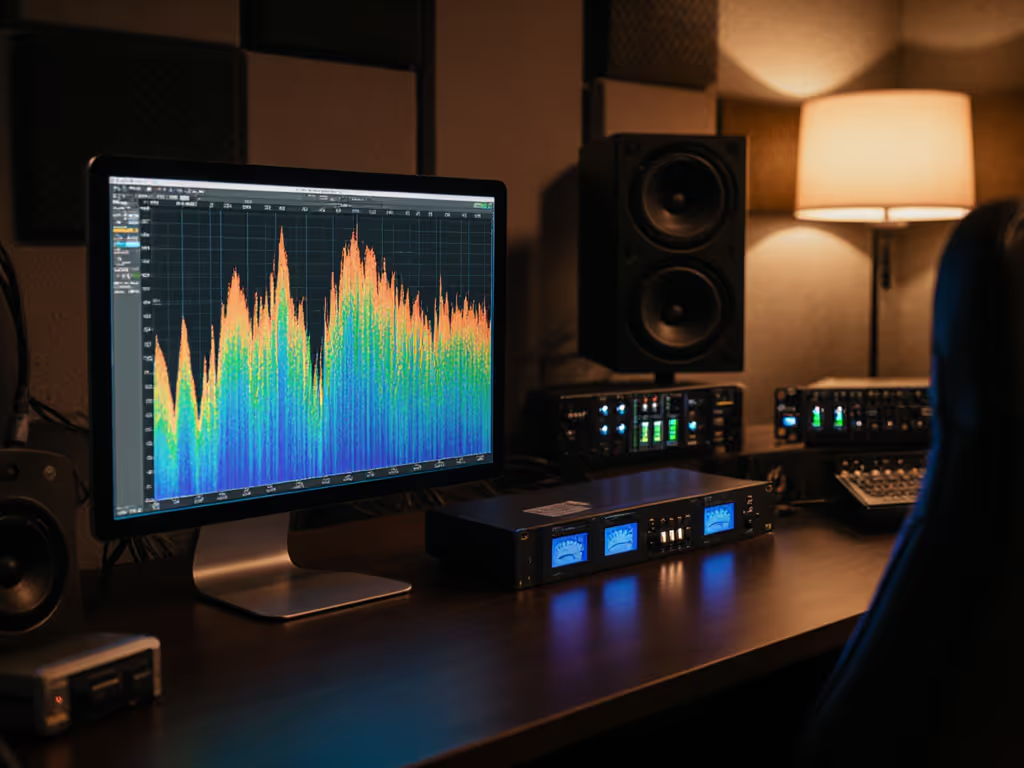
Waterfall plot analysis reveals something that frequency response graphs cannot: how long your monitors and room keep ringing after the music stops. For small-room mix engineers working at nearfield distances, this time-domain behavior often determines whether your mixes translate or require endless revisions.
I've spent years staring at flat frequency response curves that promised truth, only to hear a client's mix fall apart on earbuds. The culprit? A 200 Hz bump from the desk wasn't just a peak; it was decaying for 180 milliseconds. We trimmed desk height, adjusted toe-in, and dropped a surgical shelf. The sparkle stayed, but the revisions stopped. If desk bounce is part of your problem, see our desk reflection and monitor height guide for placement fixes that actually shorten decay.
That's when I learned: curves matter, but only as far as rooms allow. Waterfall plots show you exactly what your room is doing, not just what it measures.
What Is a Waterfall Plot, and How Does It Differ from Frequency Response?
A waterfall plot is a three-dimensional visualization that combines three pieces of information: frequency (horizontal axis), time (depth), and amplitude (vertical or color-coded). Think of it as watching sound energy decay across the spectrum in real time, frame by frame.
A static frequency response graph shows you amplitude versus frequency at a single snapshot. A waterfall plot adds the crucial fourth dimension (time) to reveal whether a peak at 80 Hz decays in 50 milliseconds or rings for 250 milliseconds.
This distinction matters enormously in compact rooms. A frequency response might look acceptably flat, but the waterfall reveals whether certain frequencies are properly damped or creating unwanted resonances that mask detail and mislead your mixing decisions. Two rooms with nearly identical frequency response can sound completely different because one has controlled decay and the other suffers from ringing that muddies the sound.
The key difference: frequency response answers "What amplitude is present?" Waterfall plots answer "How long does it linger?"
Why Does Decay Time Matter More Than You Think?
In small rooms (your 10×12 bedroom or apartment setup), room modes and boundary reflections don't just add a little bass or brightness. They trap energy. A frequency that resonates in your 8-foot corner can ring for 0.3 to 0.5 seconds or longer. While your speakers have stopped producing that 60 Hz tone, it's still bouncing between walls, coloring everything above it.
This is a time-domain problem that no flat EQ curve can fully solve. When you're mixing at 70-75 dB SPL (a realistic scenario in shared living spaces), you're not hearing the peak itself as much as you're hearing the tail (the decay that masks the next note and compounds with the next kick hit).
Waterfall plots expose this hidden cost. They show you exactly which frequencies are decaying properly versus which ones are ringing. A well-controlled frequency should show smooth, uniform decay across the plot. Problematic resonances appear as peaks that extend far back in time, indicating frequencies taking much longer to die out.
The practical outcome: when decay times are controlled, your ear makes more accurate EQ and balance decisions. When they're wild, you're fighting the room, not mixing the music.
How Do You Read a Waterfall Plot?
Reading a cumulative spectral decay interpretation starts with recognizing what a healthy plot looks like versus one with problems.
The three axes:
- Horizontal (left to right): Frequency, typically from 10 Hz to 20 kHz
- Depth (near to far): Time, often displayed in 100-400 millisecond windows for room analysis
- Vertical or color: Amplitude, showing how loud the decay is at each point
What to look for:
-
Smooth, rapid descent: All frequencies should cascade downward at roughly the same rate. This indicates even, predictable decay across the spectrum.
-
Isolated peaks extending far back: Any frequency that "sticks up" or extends deep into the plot is a resonance, a room mode or speaker boundary issue that needs attention. Bass frequencies naturally ring longer than mids and highs; a controlled 60 Hz might decay in 200 ms while a problematic 120 Hz might persist at 400 ms.
-
Cliff-like drop-offs: Sharp edges in the waterfall suggest acoustic treatment is working effectively. Soft, gradual slopes suggest untreated surfaces.
-
Frequency-specific rings: Flutter echo (that ping you hear when you clap) shows up as thin, spike-like echoes at specific frequencies in the mids and highs.
A practical rule: if everything has "waterfalled" (if the entire plot has descended to the noise floor before 400 milliseconds), your decay times are well-behaved for a nearfield setup.
Waterfall Plots vs. Frequency Response: A Practical Example
Imagine two monitors measured identically at 50 dB SPL across 20 Hz to 20 kHz. The frequency response graph shows both as flat and neutral. The waterfall tells a different story.
Monitor A: Smooth, even decay. Everything crosses the noise floor by 300 ms. Measured at one meter, the off-axis behavior is stable; toe-in changes don't shift the low-mids dramatically.
Monitor B: A sharp peak in the 150-250 Hz range that rings for 500+ ms. When you move 15 degrees off-axis, the peak collapses but creates a null at 180 Hz. Result: you lean toward the sweet spot; your stereo image narrows; your low-mid EQ choices don't translate to car or earbuds.
Both measure "good." Only the waterfall reveals which one won't wreck your mixes in a compact, reflective room.
What Causes Long Decay Times in Small Rooms?
Time-domain response analysis in typical small rooms shows decay problems from three sources:
-
Room modes: Pressure-based resonances at low frequencies (60, 100, 120 Hz) that excite when speakers are near boundaries. Bass traps help, but geometry often wins.
-
Boundary reflections: Sound bouncing off the desk, wall, or nearby reflective surfaces (glass, hard furniture, monitor stands). Desk height, speaker distance from the back wall, and toe-in angle all influence this.
-
Cabinet and port resonances: A speaker's rear port can excite room modes if placed too close to a wall. This is why nearfield monitors with controlled porting and stable off-axis behavior are critical in tight spaces. Predictable off-axis wins.
Acoustic treatment can reduce these, but spectral decay importance isn't just about absorption, it is about speaker choice and placement discipline.
How Do Waterfall Plots Guide Acoustic Treatment Decisions?
A waterfall plot shows you exactly which frequencies need treatment and whether your current approach is working.
Low-frequency decay times (below 100 Hz) typically require bass traps or subwoofer repositioning. Mid-range problems (100-500 Hz) often demand absorptive panels on first reflection points or desk/stand isolation. High-frequency ringing suggests diffusion or additional absorption on hard surfaces.
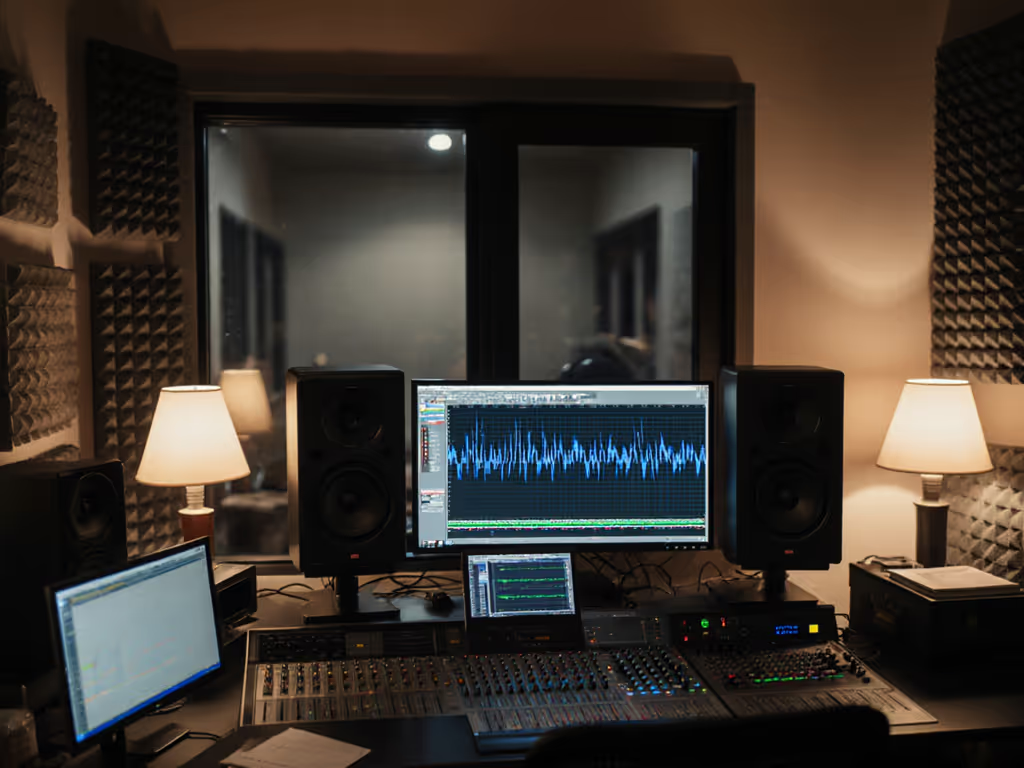
The measurement caveats: a waterfall taken at one point in your room won't fully capture behavior at all listening positions. Always measure at your ears in your seated position, at the distances you actually work. Use a 100 millisecond window for room resonances; shorter windows (1-10 ms) reveal cabinet colorations. When examining monitor time-domain performance, latency matters too, and zero-latency monitoring through your interface ensures your ears are evaluating true room response, not delayed correction. For step-by-step measurements and level-matched testing, use our home studio monitor calibration guide.
Bringing It Into Practice
Waterfall plot analysis isn't academic theory: it is a decision tool. When you understand decay times in your room, you can choose monitors with stable off-axis behavior, place them to minimize boundary coupling, and dial in room correction (if using DSP presets) with confidence that you're solving real problems, not chasing measurements.
The result: fewer revision loops, mixes that hold up on earbuds and cars, and the ability to work quietly without losing low-end truth. That's the practical promise of reading the waterfall: knowing why your room sounds the way it does, and what you can actually change.
Start by running a waterfall measurement in your own room using free tools like REW. No measurement mic yet? Get started by mapping room modes with our smartphone acoustic analysis guide. Look for decay times above 300-400 ms in the bass; note any peaks in the mids that stick out. Then move your monitors six inches closer to the sweet spot, or raise them two inches, and remeasure. You'll see the waterfall change in real time, and hear the difference in your next mix check.
That feedback loop (curves paired with context) is where small-room mixing becomes predictable.
Related Articles