Transient Response: Why Your Studio Monitor Lies About Drums
By Lila Okafor • 4th Dec
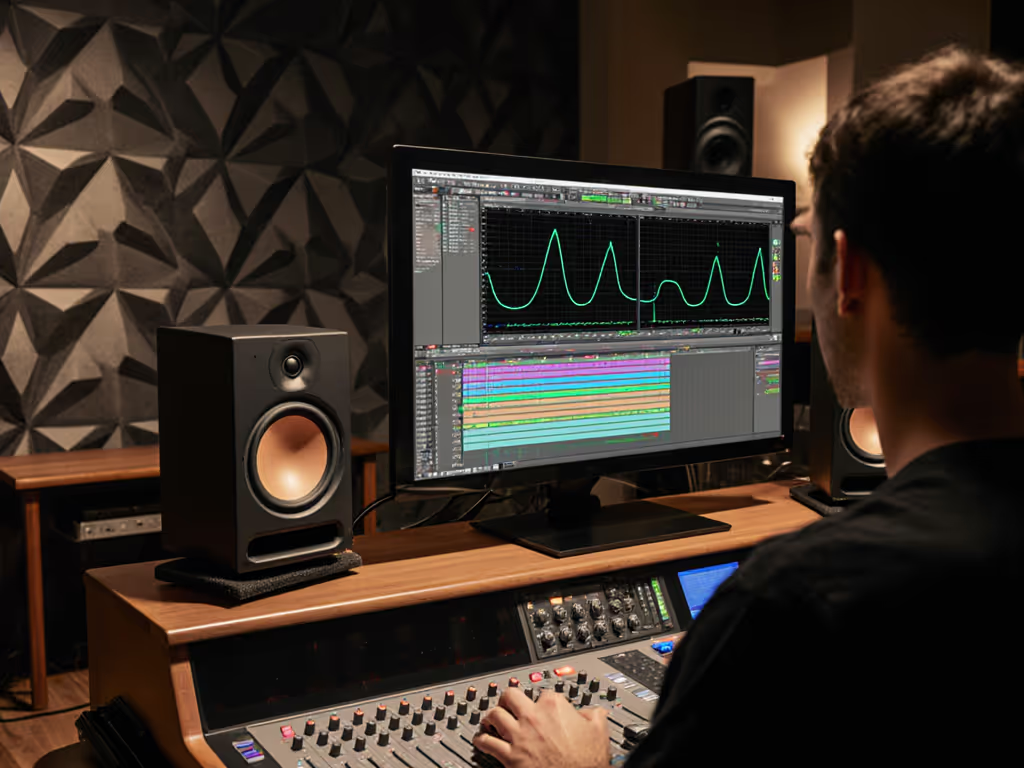
When your studio monitor fails to accurately reproduce drum transients, your mix decisions become guesses. The spike of a snare hit, the click of a kick drum's beater, these momentary events carry crucial timing and texture information that monitors often distort through poor transient response capabilities. In small rooms, these distortions compound with boundary reflections to create a false sense of attack, leaving you making EQ and compression choices based on artifacts rather than reality. Understanding monitor attack characteristics is not about "good sound," it's about identifying which timing information you can trust when your client's earbuds or car system will hear something completely different.
What Exactly Is Transient Response?
A transient is the initial high-amplitude spike at the onset of a sound wave, a millisecond-long burst of energy that defines an instrument's attack character. For drums, this includes the stick hitting the drum head, the initial air displacement from a kick drum port, or the collision of hi-hat cymbals. The importance of transient accuracy becomes evident when you consider that these events often contain significant high-frequency energy (up to 15-20 kHz) while simultaneously triggering low-frequency resonance.
Technically, transient response measures how quickly a speaker cone moves from rest to the required displacement when voltage arrives, then stops when voltage ceases, without overshoot or ringing. Measured in milliseconds, professional studio monitors should achieve under 2ms settling time. In reality, many consumer-grade studio monitors exhibit 5-10ms response times, causing audible smearing of rhythmic elements. This is not merely frequency response, it's time-domain behavior captured in speaker impulse response graphs that most spec sheets omit entirely.
How Room Acoustics Sabotage Transient Fidelity
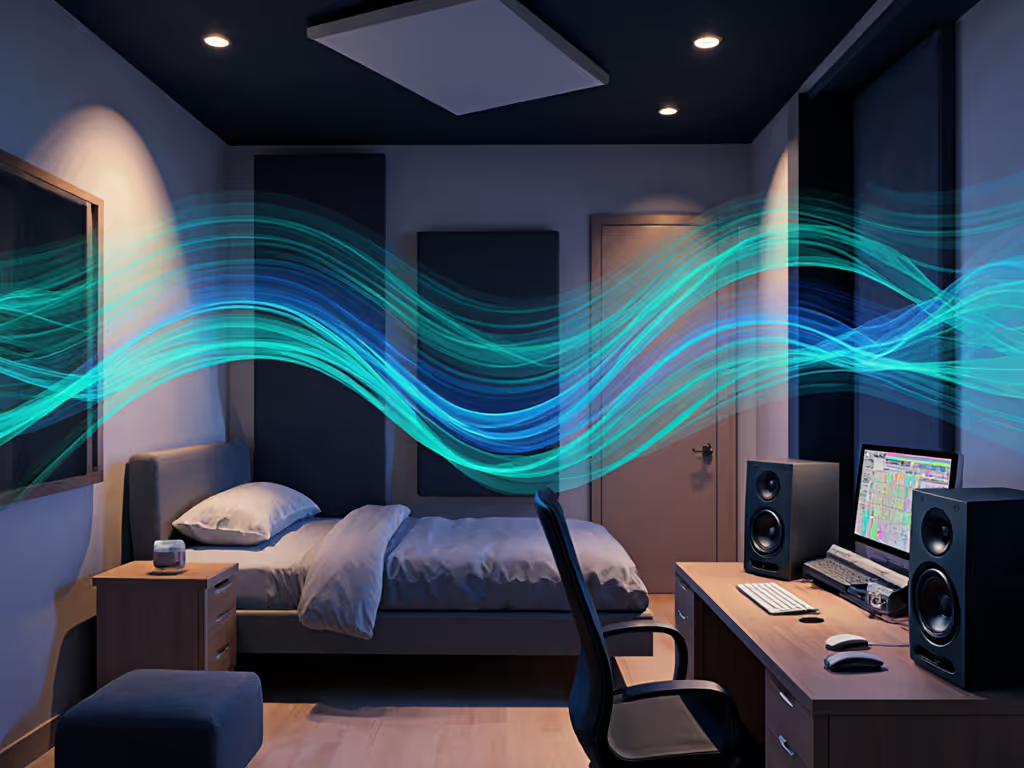
In compact spaces (under 20m³), boundary interactions dominate the first 10ms of sound propagation, precisely the timeframe where transients live. A desk reflection arriving 0.3ms after the direct sound (a mere 10cm path difference) creates comb filtering that can null out critical high-frequency attack information at your listening position. This isn't just "muddiness," it's specific frequency cancellations that vary dramatically with minor head movements.
The myth that "small rooms don't affect high frequencies" collapses here. At 10kHz, a half-wavelength is just 1.7cm, a distance smaller than most monitors' tweeter excursion. Your desk's height, the monitor's vertical orientation, and even cable placement create micro-reflections that smear transient information before it reaches your ears. To minimize these desk-induced artifacts, follow our monitor height and desk reflection guide. I've measured 8dB dips at 8-12kHz from desk reflections alone in typical 1m listening setups, enough to completely obscure the attack characteristics of shakers and hi-hats.
Why Drum Transients Are the Canary in the Coal Mine
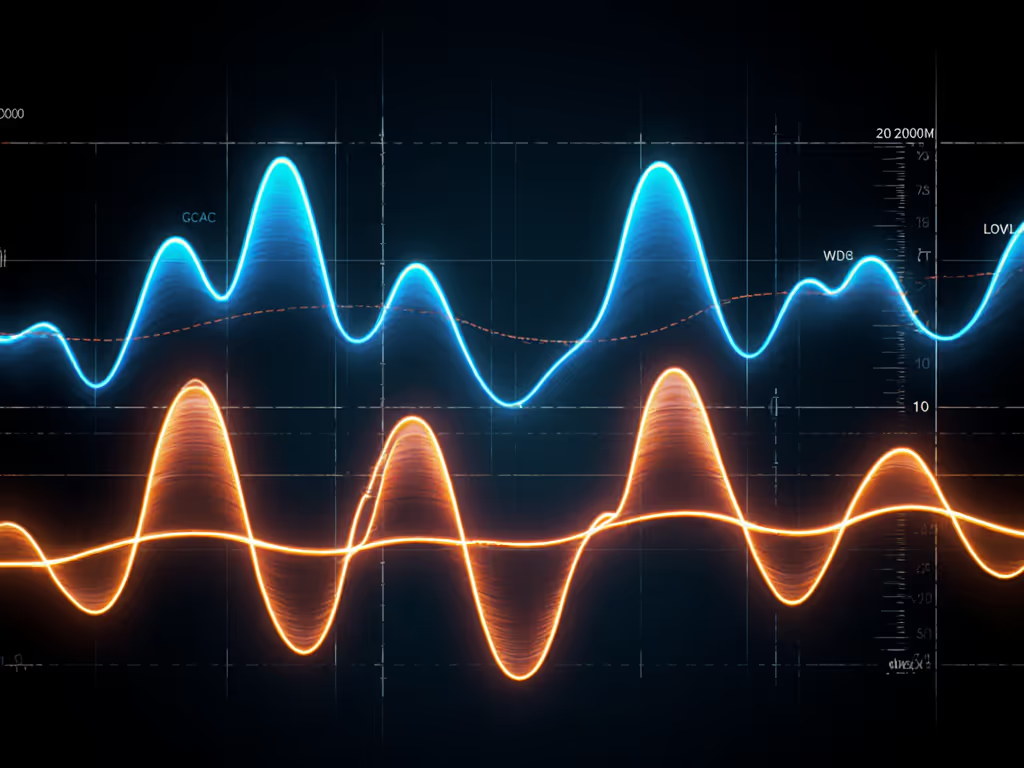
Drums expose monitor weaknesses most brutally because they contain both extreme amplitude spikes and complex harmonic decay. A snare drum's initial transient may register 105dB SPL at 1m, followed by a 30dB decay within 50ms. Monitors that compress or distort during this transition create false texture cues:
- Slow drivers smear the initial attack into the sustain portion, making drums sound "mushy"
- Overshooting tweeters add artificial "crack" that disappears on consumer systems
- Boundary-reinforced lows exaggerate kick drum "thump" while obscuring the beater click
This is where drum transient reproduction becomes your diagnostic tool. If your closed hi-hat lacks crisp definition at moderate listening levels (75-80 dB SPL), but sounds harsh when you crank it, your monitor's transient response is inconsistent across SPLs, a critical flaw for small-room engineers who must work quietly. Learn how to set healthy levels that preserve detail with our safe listening level guide.
Testing Transient Response Without Lab Gear
You don't need measurement mics to assess transient fidelity. Follow this one-meter reality check protocol:
- Play a simple drum loop with consistent snare hits (no reverb)
- Set monitor level to 78 dB SPL (use a free mobile app with A-weighting) If you're using your phone, this smartphone calibration walkthrough improves accuracy and repeatability.
- Close your eyes and focus on the precise moment the stick hits the drum
If you hear a distinct "click" followed by body, your transient response is adequate. If it sounds like "shhh-boom" with indistinct attack, you're hearing smeared transients.
Critical listening points:
- Does the snare decay cleanly or hang with artificial sustain?
- Can you distinguish between stick-on-rim and center hits?
- Does kick drum click disappear when you lower volume?
These tests reveal more about transient accuracy than any frequency sweep. Remember: what matters isn't whether you "like" the sound, but whether timing cues remain consistent across volume levels, a hallmark of good transient behavior.
The Off-Axis Connection Most Reviews Ignore
Here's what spec sheets won't tell you: transient response degrades faster off-axis than frequency response. A monitor with 6dB variation at 30° off-axis might exhibit 15dB transient smearing in the same position. In small rooms, where your head moves centimeters during mixing, this creates a false stereo image where transients "disappear" when you lean slightly.
This is why controlled directivity matters. See our off-axis response comparison to understand how dispersion affects transient clarity across the sweet spot. Monitors with waveguides or coaxial designs maintain more consistent impulse response across the horizontal plane, critical when your desk forces 60°+ listening angles. I've seen producers waste months chasing "better imaging" by adjusting toe-in, when the real issue was transient collapse at their actual listening position. Curves matter, but only as far as rooms allow.
Practical Fixes for Small-Room Engineers
Forget "acoustic treatment" as a panacea. Implement these targeted solutions:
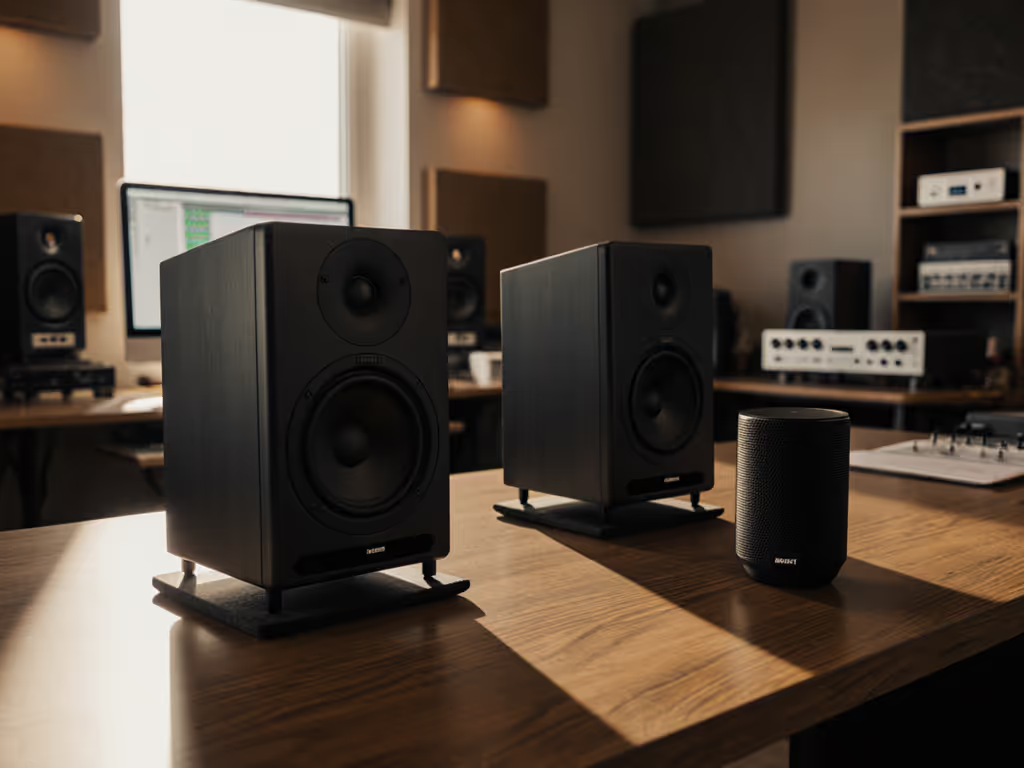
- Desk decoupling: Place monitors directly on dense material (granite > foam > air) to minimize resonance-induced smearing
- Height calibration: Position tweeters at ear level, deviations greater than 10cm create 2+ms path differences that smear transients
- Measurement caveat: Never trust single-point measurements. Move your head 5cm in all directions while listening to transients, your "sweet spot" should be at least 15cm wide
- DSP strategy: Apply 0.5ms lookahead limiting to prevent monitor overdrive on transient peaks (reduces distortion at low SPL) For deeper small-room optimization, try these advanced monitor DSP techniques.
The most effective adjustment? Reduce desk height to a minimum 15cm clearance below monitor baffles. In my measurements, this alone improved transient clarity by 3-4dB in the 5-10kHz range (where stick attacks live), by eliminating the primary reflection path.
When Good Transient Response Isn't Enough
Even monitors with excellent impulse response measurements can lie in compact rooms. A client once loved a system's "sparkly" highs until we overlaid their room's 200Hz bump from the desk. We cut the desk height, tweaked toe-in, and applied a low-latency shelf cut, the sparkle stayed, but the misleading low-mid hump disappeared. Suddenly, their drum mixes translated everywhere.
This is the core insight: transient response operates within room constraints. A monitor's lab-measured impulse response becomes irrelevant when room reflections dominate the first 5ms of sound arrival. Your goal isn't perfect transient reproduction, it's consistent, predictable behavior within your specific nearfield environment.
The Bottom Line
Stop chasing "fast" speakers and start evaluating consistent timing behavior at your actual listening position. Good transient response studio monitors deliver timing cues that remain stable across your micro-movements and volume levels, especially crucial for drum elements that define your track's rhythmic foundation. When your hi-hats retain crisp attack at 75dB SPL, and kick drums maintain distinct beater clicks across volume changes, you've achieved the only metric that matters: reliable translation to real-world playback systems.
Before your next mix session, run that simple drum loop test at multiple volume levels. If timing cues shift dramatically, you're not hearing the mix, you're hearing room and monitor artifacts. The truth about your drums exists in the milliseconds between the initial spike and the sustain decay. Find monitors that honor that space, and your mixes will finally escape the revision loop. One-meter reality check isn't just a phrase, it's the foundation of trustworthy monitoring in constrained spaces.
Related Articles