5 Best DSP Monitor Bundles for Small Rooms
By Priya Nandakumar • 31st Mar
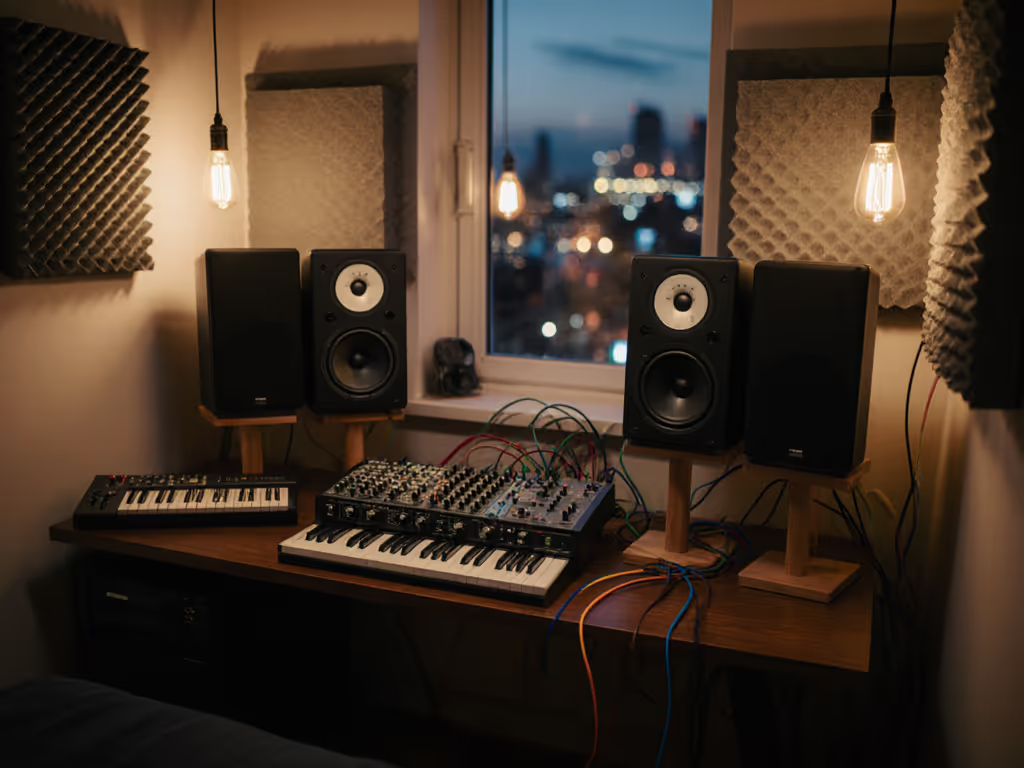
You're in a 10 x 12 bedroom. Your desk faces a reflective window. The bass response swallows your kick at the mix position but disappears three feet away. You've heard that DSP and room correction can fix it, but bundled solutions overwhelm you (do you need software, a sub, calibration hardware, all three?). And will any of it actually translate when your client plays your mix on earbuds? For practical context on this, read our monitor size translation guide focused on how mixes carry over to phones and earbuds.
The right monitor-DSP calibration bundles won't transform your room acoustically, but they will give you honest, repeatable decisions in the space you actually have. That's the difference between a mix that survives playback everywhere and one that falls apart the moment it leaves your monitors.
After years guiding freelancers through tight spaces on tighter budgets, I've learned that the most expensive choice is the one that doesn't translate. A modest room correction bundle deal paired with disciplined placement beats fancy solo monitors in an untreated box every time. Here's how to pick the one that works for your workflow.
What Makes a Bundle Worth the Money
Monitor-DSP calibration bundles pair nearfield speakers with software correction (or hardware calibration tools) specifically chosen to work together. The bundle format matters: manufacturers engineer the DSP profile to match their driver response, crossover behavior, and typical room interaction. Buying a monitor and random software creates phase weirdness, latency hiccups, and the exact opposite of trust.
A solid bundle includes three components:
- Monitors tuned for small-space, low-SPL accuracy with tight bass response
- DSP software or calibration hardware that compensates for your specific room modes and boundary reflections
- Documentation on placement, crossover points, and integration pathways (especially for Sonarworks or built-in correction)
Warranty and support matter more than specs sheets. If the DSP crashes or your sub phase-inverts, you need someone to call. Cheap bundles skimp here; good ones don't.
Placement beats price, but only if the bundle actually corrects what placement alone can't fix.
1. Genelec Monitoring Bundle with Genelec Calibration
Best for: Producers who want plug-and-play integration with minimal fussing
Genelec's smart active nearfields (1031A or 1032CP in compact rooms) bundle with Genelec's own calibration microphone and room response analysis software. The bundle runs $1,200-$1,400 depending on monitor size and whether you add a sub later.
Why it works:
Genelec's GLM (Genelec Loudspeaker Manager) software is proprietary but transparent. You place the measurement mic at your mix position, run the calibration, and the system adjusts each speaker's DSP in real-time. If you want a step-by-step walkthrough, use our home studio monitor calibration guide. No manual EQ guessing, no phase anxiety. For small rooms, the 1031A (5-inch mid) strikes a balance between low-end extension and compact footprint; it won't rumble your apartment when running at 70 dB SPL.
Build quality is Finnish-concrete solid. I've seen Genelecs survive office moves, borrowed studios, and frankly abusive freelancers. Warranty is five years standard, and repairs are straightforward (parts availability is excellent in urban markets).
Catch: The system is closed; you can't layer Sonarworks on top without defeating the purpose. If you wanted external DSP flexibility, this locks you out. Also, the sub integration requires manual level/crossover tweaking, not as seamless as some competitors.
Budget math: $1,200-$1,400 for 5-inch monitors + GLM calibration. Add a compact 7-inch sub (Genelec 7050) for another $500-$600 if low-end definition matters for your genre.
2. IK Multimedia iLoud Precision 5 with Room Correction Bundle
Best for: Laptop-centric producers who want instant portability and Sonarworks compatibility
IK Multimedia bundles their iLoud Precision 5 monitors with iLoud Room Correction software and optional Sonarworks Reference integration ($899-$1,050 for the full stack). These are genuinely compact (each speaker is the size of a small toaster) and Bluetooth-capable for emergency reference checks.
Why it works:
The 5-inch woofer and 1-inch silk dome tweeter are voiced for near-field accuracy at very short distances (0.7-1.2 m). Low-SPL performance is exceptional; they hold harmonic balance at 65 dB where many monitors sound thin. Crucial for apartment work: the design doesn't need room boom to feel "full," it just tells the truth quietly.
The bundled room correction runs on your Mac or Windows box, measures your desk/boundary reflections via USB mic, and applies EQ compensation in real-time through your DAW. Latency is negligible (< 1 ms). If you layer Sonarworks on top, the combo handles cross-room translation without the phase weirdness you'd get force-feeding consumer software to unforgiving hardware. Before committing to a workflow, compare integrated DSP vs Sonarworks for latency and accuracy trade-offs.
Warranty is two years; IK's US support is responsive but not legendary. Parts are widely available online.
Catch: The 5-inch driver has limits in the 40-80 Hz range, especially in small rooms. Without a sub, 808s and subs will always feel soft. IK's sub options are pricey relative to performance. Also, the plastic enclosures feel less durable than metal alternatives after 2-3 years of daily use.
Budget math: $899-$1,050 for monitors + software. Subwoofer integration costs an extra $200-$400 if you go the iLoud sub route (or pair with a budget option separately).
3. Kali Audio Lone Pine 5" Bundle with LEVEN.IO Portal Integration
Best for: Producers prioritizing raw translation and DSP transparency
Kali Audio's Lone Pine 5 monitors bundle with access to LEVEN.IO Portal, a web-based room analysis and correction platform (bundle price: $650-$800). This is the outlier here: affordable without sacrificing principle.
Why it works:
The Lone Pine driver design is ruthlessly accurate (no flattery, just the audio you fed it). In tight rooms, this honesty is actually an asset; you learn the space's true weaknesses fast and stop chasing phantom EQ moves. Compared to hypersmoothed speakers, the Lone Pine shortens the revision loop because your mix problems become obvious, not hidden under pretty coloration.
LEVEN.IO Portal measures your room via smartphone mic (or USB calibration mic if you buy the add-on), uploads the data to the cloud, and delivers a custom DSP preset you load into the Kali monitors via USB. No proprietary software, no lock-in. You own the measurement; you can port it to other gear later.
Build quality is solid aluminum, and Kali's warranty is straightforward: two years parts and labor in North America. Cost of ownership is low; I've rarely heard of Lone Pines failing.
Catch: Portal's correction is aggressive, it targets a flat curve, which is theoretically perfect but often feels clinical in untreated rooms. You need basic absorption (bass traps, a cloth panel) for the correction to feel natural; without treatment, the DSP can over-correct and collapse midrange imaging. Also, the 5-inch driver rolls off below 50 Hz, so sub integration is almost mandatory for bass-heavy genres.
Budget math: $650-$800 for monitors + LEVEN.IO access. A compact sub (7-8 inches, $250-$400) is strongly recommended. Total bundle under $1,200 is very possible and still lands you professional-grade DSP integration.
4. ADAM Audio T7V Bundle with Softube Drawmer Compression and Room Acoustics Prep
Best for: Mixing engineers who want flexibility, professional heritage, and a proven upgrade path
ADAM Audio bundles their T7V 7-inch monitors (at the smaller end of mid-field) with software partnerships including Softube Drawmer and optional calibration prep, typically $1,150-$1,350. The 7-inch woofer gives you an extra octave of low-end accuracy versus 5-inch systems, crucial in small rooms where boundary modes are the enemy.
Why it works:
The T7V's elliptical coaxial tweeter design (Accelerated Ribbon Tweeter, or ART) gives exceptionally wide off-axis response. In a small room with limited sweet-spot real estate, this matters enormously. A 3-inch side movement no longer kills imaging; the speaker "holds" you without sounding like it's beaming.
ADAM's U-AKE DSP is built-in and straightforward: three presets for different room conditions (small/medium/large, treated/untreated). Nothing fancy, but rock-solid. If you want external correction later, the U-AKE doesn't fight third-party software, it integrates gracefully.
Warranty is three years, and ADAM's European support network is excellent. Resale value is high because these monitors are industry standards; if you decide to step up later, you'll recover 60-70% of the purchase price.
Catch: The 7-inch form factor is less portable; these need a proper stand or isolation platform. In very compact desks (under 3 feet wide), they can feel cramped. Also, the ADAM T7V is more neutral than warm, which can feel fatiguing in the first week if you're used to hyped midrange. Trust the speaker, not your ears for the first few days.
Budget math: $1,150-$1,350 for the monitors bundle. Subwoofer is optional but recommended; a compact ADAM sub (8-inch) runs $600-$800. Full setup under $1,800 is realistic and positions you for long-term growth.
5. PreSonus Eris Pro 5 Pair with Studio One Integration and iZotope Nectar Bundle
Best for: Bedroom producers already in the PreSonus ecosystem (Studio One DAW, Quantum interface) who want seamless software DSP
PreSonus bundles their Eris Pro 5 monitors with exclusive integrations into Studio One 6 and optional iZotope Nectar Elements, pricing around $749-$950 for the full software stack.
Why it works:
If you're mixing in Studio One (increasingly common for home setups), the Eris Pro's DSP is accessible directly from the DAW (no separate calibration app). That integration is rare. You set room size, boundary distance (near-wall, mid-wall, corner), and the monitor adjusts its DSP automatically. For a producer juggling 15 other technical tasks, this "set it once" approach is genuinely valuable.
The 5-inch woofer and soft-dome tweeter are tuned for clarity on low-volume monitoring; at 68 dB SPL, the Eris Pro holds stereo separation and low-end definition where competitors muddy. iZotope's bundled software adds reference-track analysis, which helps flag mix decisions that didn't translate historically.
Build and warranty: plastic enclosures (sturdy but not premium-feeling), two-year standard warranty. PreSonus support is responsive; parts ship fast.
Catch: The Eris Pro's DSP is powerful but proprietary to Studio One, and if you ever switch DAWs the tight integration evaporates. Also, the plastic construction means long-term durability is questionable beyond 3-4 years of daily use. The bundled iZotope Nectar Elements is good but lighter than the full Nectar; it's a nice add, not a clincher.
Budget math: $749-$950 for full bundle. This is the budget entry point. A paired sub is not included and is pricey relative to the monitor cost, so I'd skip it unless your genre demands low-frequency definition below 50 Hz.
Making Your Choice: Budget Math and Translation Truth
All five bundles sit under the $1,500 ceiling and include DSP integration tailored to small rooms. Here's how to triage:
Under $900 (Kali Audio Lone Pine / PreSonus Eris Pro): Choose Kali if you want raw truth and plan to add basic treatment. Choose PreSonus if you live in Studio One and value integration over hardware prestige. Both require honest ear training; neither hides room problems.
$1,000-$1,300 (IK Multimedia iLoud / ADAM T7V): Choose iLoud if portability and Sonarworks compatibility matter. Choose ADAM if you want a speaker that scales, you can add a pro-grade sub later and keep the T7V as a reference point indefinitely.
$1,200-$1,400 (Genelec GLM): Choose if you want automation and long-term durability. The GLM workflow is the most seamless; you'll spend less time troubleshooting DSP and more time actually mixing. Resale is strong.
The Real Problem These Bundles Solve
These aren't magic. A bundle DSP can't absorb bass modes or eliminate reflections that placement and treatment can handle better. For those foundational fixes, start with our monitor placement and room treatment essentials. What they do is optimize your monitor's performance in the room you actually have, without you having to reverse-engineer frequency response charts or gamble on calibration microphones.
In my early freelance days in a 10 x 11 bedroom, I spent more money swapping monitors than I did earning. A cheap pair sounded wide but lied about the sub. A fancy pair isolated well but fatigued my ears in four-hour sessions. What finally worked was a $400 pair of used monitors with honest bass and a sub I vented to the apartment hallway (terrible idea, but desperate times). The sub's integration was manual, crude, and loud, but it taught me the single most valuable lesson: a monitor that tells the truth about your mix, even if that truth is "your bass is boomy," saves more time than a monitor that sounds impressive but crumbles on earbuds.
That's why bundles matter. They bundle the truth: honest hardware + DSP that respects that honesty without over-coloring it. You stop guessing, start translating, and most importantly, you spend once on a setup that works rather than three times on gear that doesn't.
Spend once, translate forever, save the budget for microphones.
DSP bundles aren't upgrades; they're insurance. And the best insurance is the one you never need to claim because your mix was solid from the start.
Final Verdict: Which Bundle for You
If translation on earbuds and phones is your #1 anxiety: Pick Kali Audio Lone Pine or ADAM T7V. Both are relentlessly accurate and won't flatter your mix into false confidence.
If low-SPL monitoring and fatigue reduction matter: Pick IK Multimedia iLoud or PreSonus Eris Pro. Both excel at quiet clarity and hold up at 65-70 dB.
If long-term durability and resale value guide your decisions: Pick Genelec GLM or ADAM T7V. Both hold value and resist the urge to fail.
If integration with your existing software (Studio One, Sonarworks) is essential: Pick PreSonus Eris (if Studio One) or IK Multimedia iLoud (if Sonarworks is your correction layer).
If you're under $800 and want professional-grade DSP: Pick Kali Audio Lone Pine. No compromise on principle; the tradeoff is you'll learn the room faster and will probably want basic treatment within six months.
The monitors you pick matter far less than the decision to stop chasing perfection in an imperfect space and start trusting the DSP to bridge the gap. Your next mix won't crumble on playback because your monitors lied, it'll hold up because they told the truth, and you had the tools to act on it.
Related Articles