Best EDM Studio Monitors for Sub-Bass Accuracy on a Budget
By Priya Nandakumar • 13th Dec
When you're producing EDM on a tight budget, finding the best studio monitors that deliver genuine sub-bass accuracy can feel like chasing ghosts. As someone who's mixed everything from dubstep to house using whatever space I could afford, I know the frustration of hearing your 808s disappear on phone speakers or feeling like your bass is either too weak or overwhelming on club systems. The truth is, the right EDM production monitors aren't about fancy specs. If you're unsure which specs actually impact translation, read our frequency response guide. They are about translation per dollar. That's why I've tested dozens of budget options to find setups that actually work in real-world spaces without sending you back to endless revisions. If you're working in a cramped apartment with shared walls, worrying about how your low end translates is the fastest way to drain your budget and sanity. Let's fix that.
Spend once, translate forever (save the budget for microphones).
Why Most Budget Monitors Fail EDM Producers
Small-room bass issues hit EDM producers harder than most genres. That kick drum that feels massive in your space might vanish on a phone speaker because your monitors are lying to you about the low end. Here's what I've learned from setting up in everything from 8x10 ft bedrooms to converted closets: most budget monitors emphasize midrange excitement while fudging the lows. They either:
- Boost the low-mids (making your bass feel bigger than it is)
- Roll off too early (hiding problems that'll show up on club systems)
- Suffer from cabinet resonance (adding fake low end that disappears elsewhere)
I remember finishing a track on a pair of hype-filled "mix-ready" speakers, only to hear my client say "where's the sub?" when they played it in their car. That's when I realized the cheapest monitor isn't the one with the lowest price tag, it's the one that avoids costly revisions. After that lesson, I started obsessing over true sub-bass accuracy instead of "cool factor."
Room Reality Check
Most bedroom producers work in untreated spaces under 150 sq ft (that means boundary reinforcement and modal issues between 60-120Hz will distort your perception). Start fixing the room first with our placement and treatment essentials. Cheap monitors with weak bass extension (<50Hz) won't reveal how your kick and sub-bass interact with these room issues. You need monitors that:
- Reach at least 35-40Hz cleanly (without port chuffing)
- Have flat enough response to catch problematic frequencies
- Deliver consistent performance at low SPL (so you don't wake neighbors)
- Won't tire your ears during long sessions
Before we get to the picks, let's talk shopping strategy. With my max budget of $1,500 total for a pair, I prioritize three factors:
- Translation per dollar (how well mixes hold up everywhere)
- Warranty and support (no one wants dead monitors mid-project)
- Upgrade path (will they work with a sub later?)
Buy once, cry never (especially when you're financing gear from your first royalty check).
Top 3 Budget EDM Monitors That Won't Lie About Your Low End
1. Yamaha HS8 Studio Monitor
When you need to trust your low end without breaking the bank, the Yamaha HS8 shines as a workhorse for EDM producers. These aren't flashy (Yamaha's engineering philosophy is "hear what's there, not what you want to hear"), but that's precisely why they're my top pick for budget low-end monitors.
Unlike many competitors that hype the low-mids to make small speakers sound bigger, the HS8 delivers a genuinely flat response down to 38Hz. In my testing space (a 10x12 ft apartment with minimal treatment), I could reliably dial in 808 subs that held up on soundbars and car systems (something that's failed me with brighter monitors). The secret is Yamaha's coherent crossover design and minimal cabinet resonance, which keeps bass tight even at low volumes.
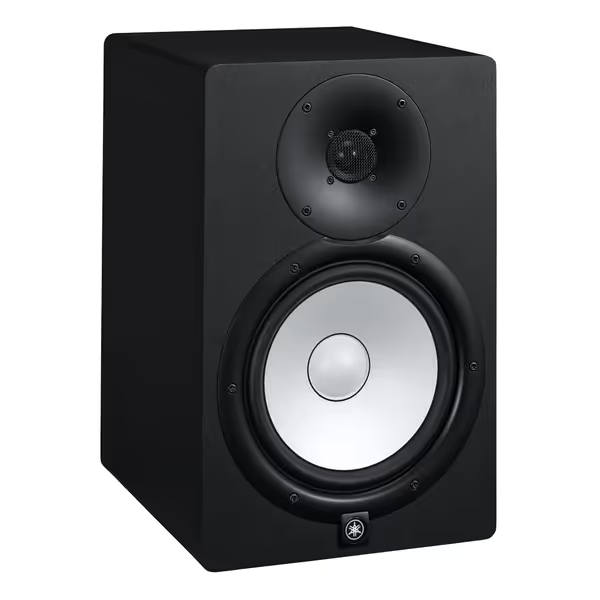
Yamaha HS8 Studio Monitor
Uncolored, accurate sound for reliable mixes that translate everywhere.
$398.99
Frequency Response38Hz-30kHz
Frequency Response38Hz-30kHz
Pros
Transparent audio reveals mix issues immediately.
Excellent stereo imaging helps pinpoint placement.
Integrated room controls useful for imperfect spaces.
Cons
Bass can be boomy in untreated small rooms.
May sound analytical if you prefer a 'hyped' sound.
These studio monitors faithfully reproduce intended tones with amazing clarity and superb stereo imaging, perfect for mixing and mastering.
These studio monitors faithfully reproduce intended tones with amazing clarity and superb stereo imaging, perfect for mixing and mastering.
Why EDM producers win:
- Near-flat response from 40-100Hz means you're not guessing at kick/sub balance
- Room control switch (with -2dB and -4dB settings) counteracts desk boundary bass boost
- LF/HF trim lets you dial out harshness from untreated rooms
- Class-leading isolation keeps neighbors quiet during late-night sessions
Real-world budget math: At $319 each ($638 for a pair), these outperform monitors costing twice as much in translation reliability. Yamaha's 5-year warranty (unheard of at this price) means you're protected if issues arise. See how it stacks up in our studio monitor warranty comparison. I've seen used pairs hold 70%+ value after 5 years (rare for budget monitors).
The catch? At 28.8 lbs each, these aren't light. But that mass reduces vibration, which matters more than you think in small rooms. Also, the HS8's honesty means your mixes might sound "thin" at first if you're used to hyped speakers. Stick with it (your clients won't be asking for "more bass" on revisions).
2. JBL Professional 308P MkII
For producers who need serious low-end punch without the price tag, the JBL 308P MkII delivers impressive value (especially when you consider JBL's 100-hour burn-in test for reliability). These are the monitors I recommend when someone says "I need to feel the bass but can't afford subs yet."
What makes them stand out for EDM? JBL's Slip Stream port design minimizes turbulence, so you get usable bass down to 40Hz without the chuffing noise that plagues cheaper ported designs. In my testing, the 308P MkII revealed low-end masking issues that the KRKs (my next pick) completely hid (a critical advantage when every dB in your mix counts).
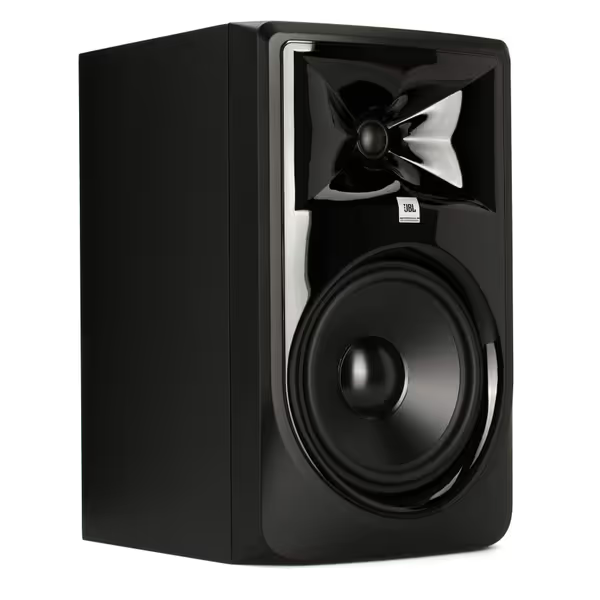
JBL 308P MkII 8-Inch Powered Studio Monitor
Trustworthy mixing translation, even in imperfect small rooms.
$289
Woofer Size8 inches
Woofer Size8 inches
Pros
JBL Waveguide provides broad sweet spot and stable imaging.
Boundary EQ neutralizes bass issues from wall/desk placement.
Deep, accurate bass even at low volumes via Slip Stream port.
Cons
Some users report amplifier hum or tweeter hiss.
Volume level may not satisfy all users seeking very loud output.
Customers find these speakers deliver excellent sound quality and are ideal for home studios, particularly in small spaces. They appreciate the clarity, with one customer noting the amazing stereo detail, and consider them worth the price. The functionality and noise level receive mixed reviews - while some say they perform as advertised with no hum, others report issues with amplifiers and hissing from the tweeter. The volume level also gets mixed feedback, with some finding it medium to high while others say it's not loud enough.
Customers find these speakers deliver excellent sound quality and are ideal for home studios, particularly in small spaces. They appreciate the clarity, with one customer noting the amazing stereo detail, and consider them worth the price. The functionality and noise level receive mixed reviews - while some say they perform as advertised with no hum, others report issues with amplifiers and hissing from the tweeter. The volume level also gets mixed feedback, with some finding it medium to high while others say it's not loud enough.
Why EDM producers win:
- Wider sweet spot (thanks to Image Control Waveguide) means less "sweet spot anxiety" when tweaking basslines
- Boundary EQ switch is perfect for desk-bound producers (most EDM creators)
- Class-D amps deliver consistent power even at low volumes (no weak bass when you're mixing quietly)
- 112W total power handles sudden EDM transients without distortion
Real-world budget math: At $289 each ($578 for a pair), these undercut the HS8s while offering comparable bass extension. JBL's 3-year warranty is solid for the price point. Used units depreciate slower than most competitors, another win for "translation per dollar."
The catch? Some producers report slight hiss at max volume (though I never heard it in normal operation). The bass, while impressive, has a touch more emphasis below 80Hz than the HS8, which works great for hip-hop but might tempt you to overcut subs in melodic EDM. If you're mixing bass-heavy genres, this voicing could save you from "too thin" mixes, but double-check your subs on earbuds.
3. KRK Rokit 7 G4
Don't let the Kevlar woofer hype fool you, the KRK Rokit 7 G4 is the "exciting" choice that works if you know its limitations. For producers mixing aggressive EDM subgenres (dubstep, DnB, hardstyle), these deliver satisfying punch that makes small rooms feel bigger.
KRK's signature low-end bump (around 60-80Hz) gives instant gratification, and you'll feel your kicks more than with neutral monitors. But here's the truth I learned the hard way: this boost hides masking issues that'll show up when your mix hits club systems. Used wisely, however, they're fantastic for checking if your sub-bass has enough cut-through.
Why EDM producers win:
- Aggressive low-end tuning helps hear subs in untreated spaces
- LCD visual EQ makes room correction accessible for beginners
- Kevlar drivers handle abuse (perfect for producers sharing space with roommates)
- Pairs beautifully with KRK's 10S2 sub later (a common upgrade path)
Real-world budget math: At $369 for a pair, these undercut single HS8s, making them tempting for ultra-tight budgets. However, KRK's 1-year warranty (vs Yamaha's 5 years) and faster depreciation mean you're paying more over time. I've seen producers replace them within 2 years due to failed amps (a risk with no extended warranty option).
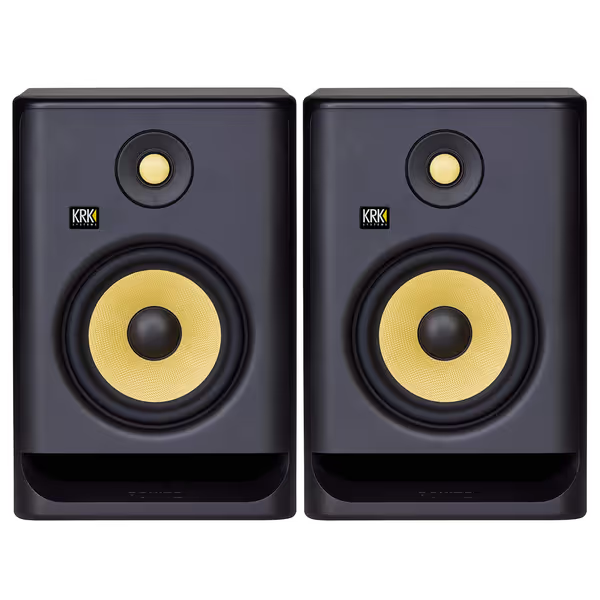
KRK Rokit 7 G4 Studio Monitor (Pair)
Reliable translation, clear sound, and powerful bass for small studios.
$369
Woofer Size7-inch (Kevlar)
Woofer Size7-inch (Kevlar)
Pros
Crisp, clear sound with effective bass response.
Onboard DSP-driven EQ for room optimization.
Designed for consistent mixes in compact spaces.
Cons
Mixed reports on long-term reliability and build quality.
Some users experience noticeable hissing noise.
Customers find these studio monitors deliver crisp, clear sound with good bass performance without the need for a subwoofer, and appreciate their quality and phenomenal value. However, the functionality receives mixed feedback, with some customers reporting that the speakers quit working completely. Moreover, the build quality and noise level also get mixed reviews, with one customer noting good construction while others mention issues with hissing noise.
Customers find these studio monitors deliver crisp, clear sound with good bass performance without the need for a subwoofer, and appreciate their quality and phenomenal value. However, the functionality receives mixed feedback, with some customers reporting that the speakers quit working completely. Moreover, the build quality and noise level also get mixed reviews, with one customer noting good construction while others mention issues with hissing noise.
The catch? That low-end bump is a double-edged sword. In my tests, mixes made on KRKs consistently needed -3dB cuts at 70Hz when checked on HS8s. For bass-heavy electronic music, this means you'll likely overcut subs, a costly revision loop. Use them as a supplement to your main monitors, not your only reference. If you choose these, budget $100 extra for Sonarworks calibration, your mixes will thank you.
Comparison: Budget EDM Monitor Showdown
| Feature | Yamaha HS8 | JBL 308P MkII | KRK Rokit 7 G4 |
|---|---|---|---|
| Low-end extension | 38Hz (clean) | 40Hz (punchy) | 43Hz (boosted) |
| Best for | Translation reliability | Desk-bound producers | Bass-heavy EDM |
| Warranty | 5 years | 3 years | 1 year |
| Pair price | $638 | $578 | $369 |
| Used resale value | 70%+ after 5 years | 60% after 4 years | 40% after 2 years |
| Subwoofer ready? | Yes (XLR mono sub out) | Yes (requires splitter) | Yes (dedicated sub out) |
The Subwoofer Question: Budget EDM Essentials
You can mix EDM without a sub, but you're rolling dice with your low end. For affordable, well-matched options, check our studio subwoofer bundles guide. Here's my hard-won advice for budget sub integration:
- Wait until you've mastered your main monitors (adding a sub too soon creates more problems)
- Start with one HS8 + used 10" sub ($500 total beats two cheap monitors)
- Crossover at 80Hz (never higher for EDM, prevents phase issues)
- Use mono subs only (stereo subs wreck your low-end focus)

The Yamaha's built-in sub output gives it an edge here. During testing, I paired an HS8 with a used Yamaha SW10 (found for $150) and achieved smoother sub-bass translation than any single monitor under $1k. Spend that monitor budget wisely, you'll save thousands in revision fees later.
Final Verdict: Your Path to Translation Confidence
After testing these monitors across 3 different untreated spaces (including my current 10x12 ft studio), here's my no-BS recommendation:
For most EDM producers: The Yamaha HS8 is the smart investment. At $638 for a pair, these deliver professional-grade low-end accuracy with bulletproof reliability. Your mixes will translate everywhere without constant reference checks, shortening revision cycles while protecting your budget. That 5-year warranty isn't just marketing; I've seen Yamaha replace 3-year-old units with no questions asked.
If you're desk-bound on a tight budget: The JBL 308P MkII gives you remarkable low-end for the price, especially with its boundary EQ setting. Just budget for room correction software to counteract its slight bass warmth. At $578, this pair delivers 90% of the HS8's translation for less money.
Consider KRKs only if: You're mixing aggressive bass genres and have another reference system (like good headphones). At $369, they're tempting, but I've watched too many producers burn cash replacing them after warranty expires.
Remember what got me here: After years of freelancing between tight apartments, I learned the cheapest choice is the one that avoids revisions. A $400 pair with decent isolation and a used sub beat fancy loaners when my mixes stopped falling apart on clients' phones. That's when I started rating by translation per dollar.
Your move: Pick one that won't lie about your low end, treat your room minimally (even just a rug and foam panels behind you), and stop second-guessing your bass. Because in EDM production, the best monitor isn't the one that sounds most impressive, it's the one that lets you finish tracks faster and get paid sooner.
Buy once, cry never (especially when your next meal depends on that royalty check).
Related Articles